Cutting to the Pain: Our Internal Tug-of-War
(The Wisdom of the Crazy Explained)
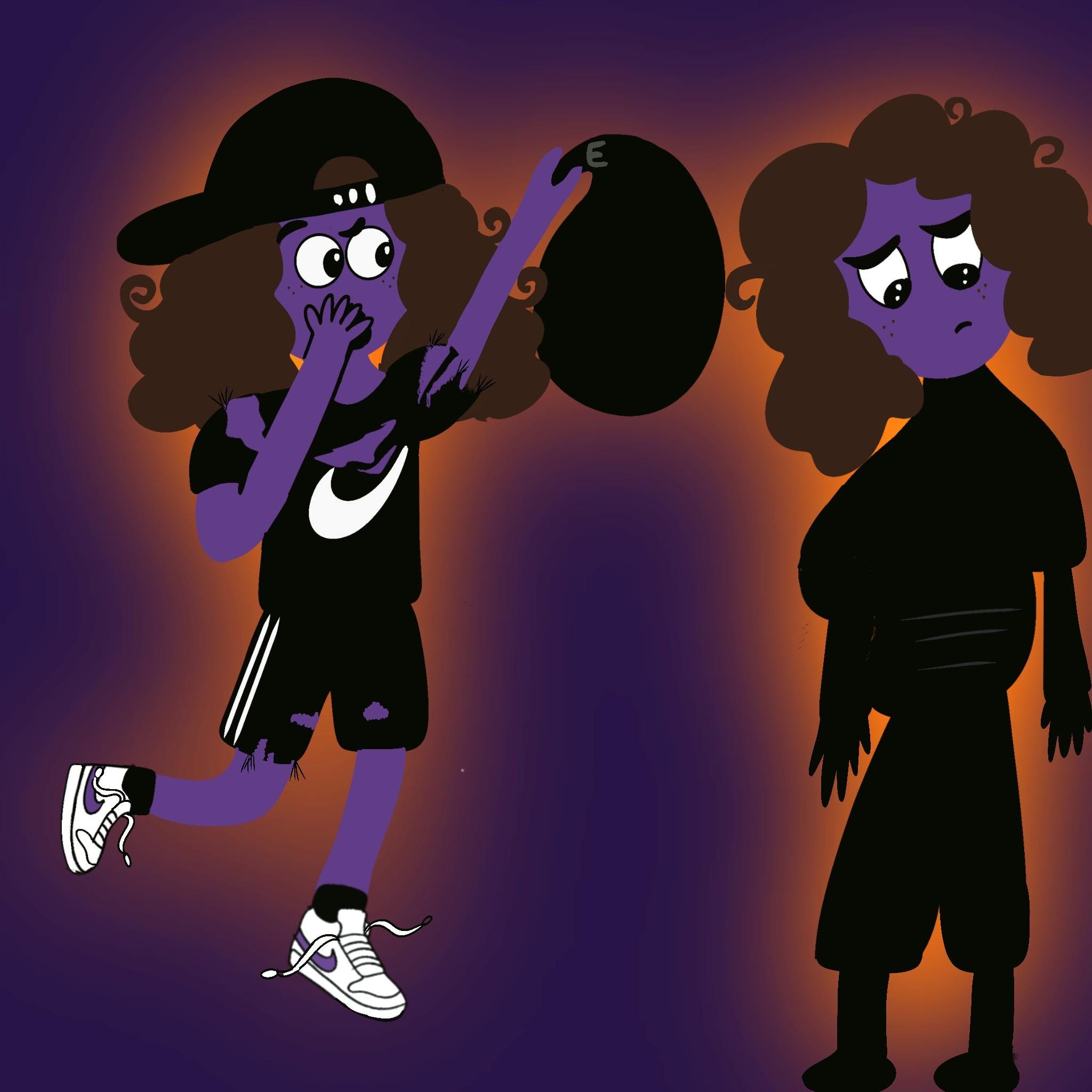
I posted the cartoon illustrations and poem that goes along with this piece in my last post, but I know these concepts can feel a bit abstract. I wanted to give a real explanation of how this shows up in our lives.
While the “extreme” side of mental health struggles can feel loud and obvious, it’s apparent to me that these crises are caused by the exact same things every single human being experiences on a daily basis. We are all navigating the same spectrum; some of us are just further along the line than others for many different reasons. our life circumstances, the events we’ve survived, the number of years we’ve spent in suppression, the depth of our sensitivity, and the resources we have (or don’t have) to process our pain.
The Pendulum from Suppression to Eruption (or vise versa)
I created this because as I experience my own emotions and look at the world, I see so many of our emotional states swinging between the Ninja’s (ego’s) silence and the Ninja’s (ego’s) Sprint. I wanted a way to illustrate what it actually feels like underneath it all. The most valuable thing I have ever learned in life is that in either of those states, the best way to heal is to cut to the underlying pain.
This piece is my attempt to show where our “mental health” symptoms actually come from—from the inside out. I’ve noticed that people often swing between two extremes: one end is suppression and flatness, and the other is a flood of extreme emotions and urgency. We see these swings in the “major” moments of a mental health crisis, but these are actually the same exact things happening in the “minor” moments of every single day—in the conversations we avoid and the ways we suppress our own feelings.
While I’m someone that often feels the “flood,” that usually only happens after I’ve spent too long on the first half of the spectrum. Whether it’s living in suppression for years until we erupt into mania, or simply allowing someone to walk all over a small part of us without speaking up until we explode in anger—the root is the same. Whenever I suppress a part of myself, it eventually erupts with an insane amount of panic, urgency, and anxiety. And what underlies all of that is a deep, deep sadness.
The Invisible Ropes (The Ninja)
I’ll start with the extreme end: severe mental health struggles like hypomania. As I’ve written before, my “authentic self” was messy, curious, creative, loud, sensitive, and playful—and unfortunately, she wasn’t always met with acceptance. While I loved this girl, one day a Ninja came and took her away.
He found a more presentable, acceptable replacement. I began living in a state of high-functioning flatness—the girl who would sit down, shut up, and listen. I suppressed my real needs and desires in order to receive love. ADHD medication became the glue for this performance; it was something I chose to do to myself. I was an accomplice to my own kidnapping.
The Ninja chose “Presentable” over “Powerful,” “Pretty” over “Playful”, “Studious” over “Curious”—all the things I thought would please people who weren’t capable of seeing my light. While the world praised the “Pink Girl” on the outside, the “Purple Girl” inside was heartbroken. It’s important to realize that oftentimes, suppression isn’t born out of self-hatred; it is born out of protection. The Ninja is just trying to keep you safe in environments that don’t feel safe for who you actually are.
While the Pink Girl isn’t tied up, she is held by “Invisible Ropes”—internalized judgments we recreate so no one else has to. For me, that was sitting down, shutting up, taking adhd medication and pleasing others. So technically pink girl is “free”, but not truly, because she’s only as free as her fear of getting locked up allows her to be. And she may be receiving more praise, but even when you receive praise for the performance, it feels hollow. You aren’t being loved; your mask is being loved, and you are stuck inside watching it all in pain.
The Eruption of the Self
Eventually, the rope snaps because you’ve realized enough truth. Every time I was truly seen—for the writer, the artist, or the messy, sensitive soul—the betrayal of my own suppression became too loud to ignore. When the flood finally came for me, it appeared as hypomania.
But what really was mania? It was an eruption of long-suppressed wisdom screaming because it had been locked in a dungeon for too long. When a core part of the self is exiled, it doesn’t just sit quietly; it stews in its own unmet needs, pain, and anger. It is starving to be seen, heard, and free. When it finally breaks through the floorboards, it looks “crazy” because it is fighting for its life.
In that state, I felt more “inherent and real” than I had in a long time, but I was in an extreme panic of: I knew it, I knew it, I knew it! There is a frantic urgency to this freedom because that part has no idea how long the window will stay open before the doors are slammed shut again. It feels it must make up for all the lost time in a single, breathless moment.
The Sprint
When the Ninja realizes he can no longer keep this part silenced, he shifts roles: instead of silencing he starts to sprint. And when he sprints you begin to sprint after him. He starts to run because he is terrified of the moment you finally catch up to him. If you catch him, he has to face the pain and the shame of being the one who locked you away this whole time. He doesn’t believe you could ever understand that he did it to protect you; he only sees the deep hurt he caused, and he runs because he thinks the truth will destroy the both of you
The Ninja keeps you running after him at a speed that makes it impossible to touch the ground, outrunning the very sadness that would actually allow you to heal.
When I went to the psychiatrist, they told me, “We have no idea why this happens, there is no reason it is just random and happens to some people around the age of 25, and you probably need medicine for life.” Something about all of that felt deeply wrong, and deeply similar to how I felt when being diagnosed with ADHD. You are being made to feel like a problem, like something just is randomly wrong and it must be fixed and the only way it can be fixed is with medication. That seems like such a short cut to what is actually going on, and what will actually be good for ourselves in the long run. I had just got off adhd medication and fully stepped back into myself and shutting myself out was the very thing that caused it. There was deep wisdom within the “craziness” that shouldn’t just be medicated and made to feel irrational. Numbing the truth is what caused all of this to begin with. Mania isn’t the answer—it was just another way to outrun the pain—but at least it gave me a look into the truth.
The Ninja in everyday life
These aren’t just clinical cycles; they are the daily negotiations we make with our own souls on a daily basis.
The Path of Suppression (The Ninja) This is the high-functioning flatness that feels safe, but hollow.
Social Muzzle: You want to be open and connect with others, but the Ninja whispers that you’re annoying. He muzzles you to “protect” you from rejection, leaving you standing in a room feeling heavy and alone.
Peacemaker: You avoid hard conversations to “keep the peace,” telling yourself it’s professional. You silence your own needs until the part of you that deserves respect is completely buried.
The Stolen Career: You choose a “safe” path to be accepted, eventually believing you simply “lack passion.” You aren’t lazy; you’ve just been dissociated from your spark for so long you can’t feel anything anymore.
The Path of Eruption (The Sprinter) When the Ninja’s ropes finally break, the energy erupts into a frantic, high-velocity fight.
The 3:00 AM Scream: The silence turns into a midnight panic. You are shaking with a level of anger and pain that feels “crazy,” but it’s actually the part you erased finally fighting for its life.
The Unworthy Sprint: the desperate need to outrun the feeling of being “not enough.” You stay in a state of constant overworking and “doing” because the moment you slow down, the shame catches up. You feel that if you aren’t producing, you don’t deserve to exist.
In either case—whether we are locked in the Ninja’s silence or chasing him in his frenzy—we are avoiding the same thing: the deep pain and shame underneath. These symptoms aren’t random glitches, they are different survival strategies for the same wounded part. The key is to negotiate with the Ninja, to get him to slow down and reveal his face so we can finally confront the fear that keeps him running and touch the pain he’s been guarding.
Thank you Ninja
For a long time, I had no appreciation for these “protectors” because I was so hurt by the suppression. I only saw the cost: how it “dims your light” and makes you rigid, numb, and less “you.”
But on the other hand, feeling into your pain while a threat is still active would be dangerous. The Ninja is a teammate keeping you safe so the “Spark” doesn’t get extinguished by the chaos. I think about doing mushrooms during this war in Israel—your whole system would want to break because you would feel everything so deeply that you couldn’t function.
As much pain as I’ve felt from betraying myself, I now understand these protectors. Sometimes I don’t get to be as open, playful, sensitive, or creative as I love to be, but they are guarding me so that when I do feel safe, I can step back into myself without being destroyed.
The ultimate goal
In any state—anxiety, numbness, or mania—the only way back to peace is to cut to the pain. We must slow the ninja down so you can touch the root, the pain, and the extreme symptoms begin to fade and you come back into your body.
In my cartoon, the Ninja says: “I didn’t do this to you, I did this for you.” The goal isn’t a static “middle” where you are always half-protected and half-exposed. The goal is flexibility.
We can think of it as a scale from 1 to 9.
The “1” is the Dungeon (Suppression): This is “high-functioning flatness,” a form of functional dissociation. You are safe, but you are also a ghost.
The “9” is the Spark (Vulnerability): This is the “Purple Girl” without the mask, letting in the pain. This is “the Self”—the only place where true healing happens.
The “Sprint” (Hyper-arousal): This is the danger zone. When the doors to the dungeon blow open and you try to reach for the truth (the 9), the Ninja often panics. He takes that raw energy and turns it into a frantic sprint (mania or workaholism) so you don’t have to actually touch the pain. You are finally awake, You get the truth of the 9, but none of the clarity because you’re still running away from yourself and your pain.
If “9” is being totally open to truth AND pain, and “1” is being totally protected by the Ninja , we absolutely need the ability to go to a “9” when we are in a safe environment. A 9 is necessary to live a full, meaningful life, connected to yourself and to others. Then, we need the Ninja skills to bring ourselves back to a “5” a place where we are still connected to ourselves, but protected enough to function when we are working at a hospital or living through a war in order to function.
When you allow yourself to go to a “9,” sometimes and really sit with your pain, your connection to yourself grows, your strength grows, your resilience grows. You start to find that you can handle the difficult times at a “6, 7, or 8” instead of a flat, numb “3.4. Or 5.” Your capacity for life expands, your capacity to understand yourself and others expands.
We all go through things in life where we have to disconnect from ourselves in order to survive, its not about never disconnecting, but its about always processing our pain and stepping back into ourselves once we truly can.
When we choose to stay connected to ourselves, that means being there even and especially through the pain, loving the wild girl enough to know she doesn’t just deserve to exist in the world, but that the world deserves to have her in it. That is the ultimate paradox of healing: the very thing that once saved your life eventually becomes the thing that prevents you from truly living it.
Continue Reading
The Knight Standing Guard, between Our mind and Our Heart
How our inner protectors sever our connections, and what it takes to reclaim true empathy, first for ourselves, and in turn for others
The Mercy of the Mirror
When the mask finally serves the soul; A Purim Journey from Self-Abandonment to Sacred Reveal
The Only Way Out Is Through
What you avoid will free you — come into the narrow place