Growing Strong in Our Roots
The Journey of Reclaiming the Selves We Buried to Belong
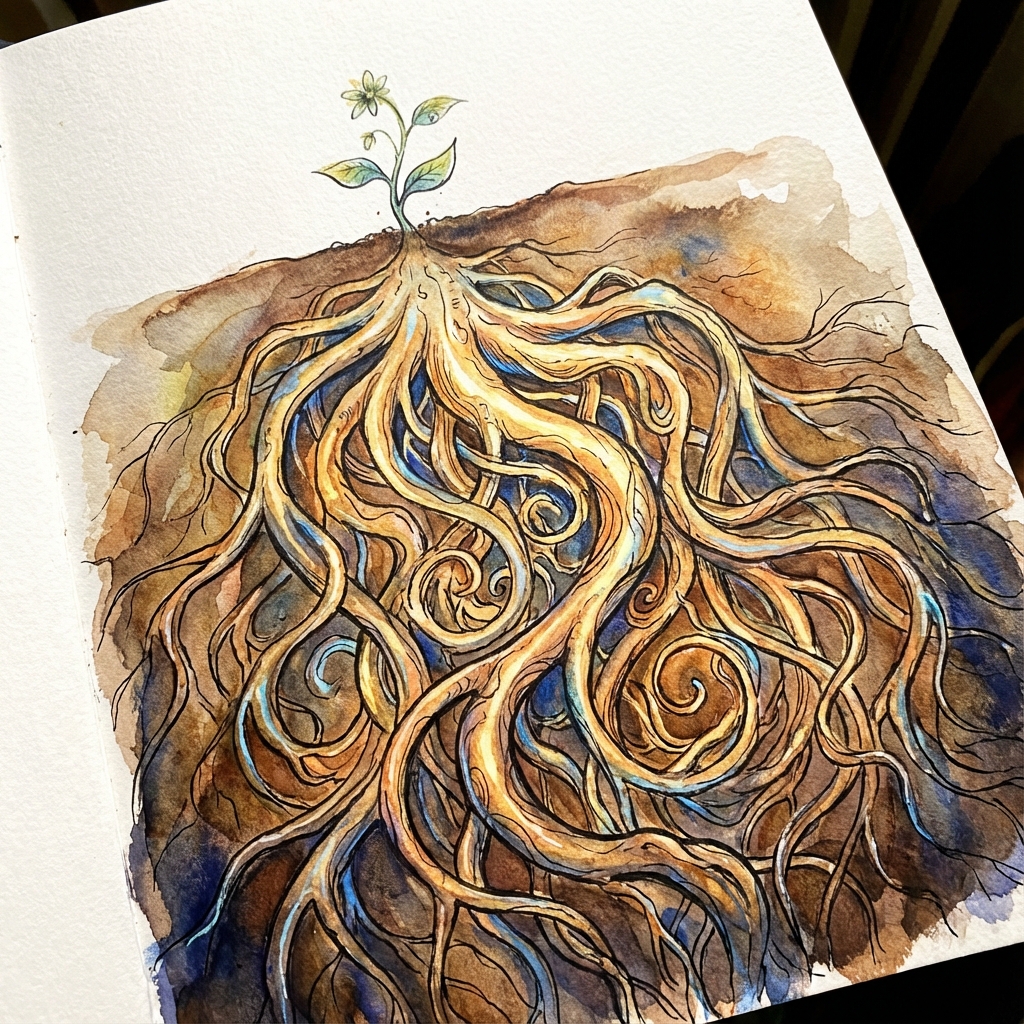
The other week I jotted down a quote in my notes that really resonated with me: “When a flower doesn’t bloom, you change the environment, not the flower.”
As someone who’s spent most of her life shape-shifting to meet the needs of her environment—changing herself instead of questioning the soil—it hit me hard.
That quote feels like the heartbeat of everything I’ve been working through and the core of my mission with sharing my pieces: the pain of misalignment, and the quiet, brave work of returning to who you were before you had to adapt.
Since moving to Israel, I’ve felt something shift. I’ve been able to come home to parts of myself that I kept hidden for so long. Parts that used to feel like liabilities, that now feel like my strengths.
In therapy and in writing, I’ve come to understand myself in parts—my core identity and emotional identities I formed to survive different seasons of my life.
There’s Dennis, the part of me who showed up as a tomboy—raw, wild, goofy, and deeply insecure about not being “feminine” enough. Dolly, the dreamer and poet, who felt everything too much and often hid in her room writing, afraid no one would understand her sensitivity. And Double D, the moral protector who was brutally honest—desperate to never be seen as selfish or bad, even if it meant abandoning herself.
These were my core selves. The ones that felt the world too deeply and got hurt for it. And so, I created others to protect them.
Danielle, who became everything Dennis wasn’t—polished, pretty, controlled. Devon, who kept Dolly’s wild feelings in check with logic, ambition, and performance. And Debbie, who made sure Double D never looked like the bad guy—always humble, always giving, always putting others first.
These parts helped me function. Helped me survive. But they also buried who I really was underneath layers of performance and protection.
Dolly is my heart. She’s the poet, the emotional one, the dreamer. The one who writes, reflects, spirals, loves big, aches deeply, and never stops asking: what does it mean to be human?
She’s also the one who got hurt the most. The one who hid in her room writing poems. The one who longed the hardest to be understood—but always felt she was too sensitive, too dramatic, too weak.
I recently came home to Seattle where I’ve been forced to encounter many of the lingering things I have left behind.
Moving to Israel has really allowed me to fully step into the parts of myself that I no longer feel are hidden. I feel like I have made so much progress while being there, really showing the world Dolly, Dennis, and Double D and being not only accepted for them but loved for them.
I took a huge leap and started to share Dolly more with the world. A version of myself I have kept away for only a very select few in my life to see.
Dolly carries so much pain still and she really is where so much of the pain I have written comes from. She was the one that hid because she felt no one could understand her sensitivity. She felt like she was made to feel worthless. She spent so much of her childhood in her room, alone, crying, writing poems to herself.
But she also is in large part the one who ultimately convinced Dennis and Double D to change along with her because she was the one that so badly longed for love, connection and acceptance.
As I started writing and sharing my side of my story, I was worried difficult feelings with my parents would start to surface.
Not just with my parents but as a writer you need to understand that difficult things with every person in your life will start to surface, because well that’s just the nature of this rodeo.
Everyone has different perspectives, everyone has a million different feelings, parts of themselves at play and ultimately, everyone is really just trying to do their best.
When I write about my life it is never to point fingers, to blame, to hurt, to ruin people’s lives, “expose them” or “make them pay.” For one, it is a way for myself to grapple and make sense of my own life, but really it is also just to share a very true story of identity that each and every one of us go through, and I can see it, I can feel it.
And so many of people’s real stories have helped me. And you can’t get to anyone’s real story if they are so worried about painting everyone in a positive light at all times, including myself. That defeats the whole purpose.
To expose what is real certainly isn’t always pretty, but it always holds beauty. And what is real for one character in a story might not feel “real” for another character. But what is felt by each character—that is what’s real, because that is what we can learn and grow from.
Anyways, my point in saying this is that when I came home, ultimately I feared my parents would be hurt by me. That they wouldn’t understand. That “I remembered it wrong.” That they would fear what others thought. The ways in which I painted them.
And honestly, that is extremely fair. We are all human and if we feel our sides aren’t accurately portrayed it can feel unfair, unjust, “wrong.”
It deeply pains me to think about my parents thinking that I am doing something harmful to them. I love them, I am extremely grateful for them, and I know from the bottom of my heart they are each amazing people who deeply care about me.
This is simply a story of becoming. And becoming includes the very real feelings that kids experience growing up. The whole point is to show the story, not the ending. And the story begins with feeling like a powerless kid who was susceptible to parents’ needs and judgments, even if those parents were amazing people who at all times were doing their best.
Which really brings me to something I have been grappling with ever since I started writing: how our perspectives are ever evolving.
Your perspectives are always changing and so sometimes, to me, it has felt pointless to put anything out at all.
I have this fear that people will tie me to my perspective at any given time.
This has especially been difficult for me because I am exposing parts of my story very slowly. I am starting from when I was a child. Of course my feelings as a child towards my parents have grown, evolved, and changed immensely.
But if I start with that, how will I ever show what I am trying to show… the literal growth, the change, the process?
Anyways, if I am going to do that I can’t just start putting out where I am at now. So my fear has been being okay with putting out things that aren’t an accurate portrayal of where I am now, but the beginning of my journey towards where I am now.
So I keep letting fear crawl back into me— “Like was there ever a need to say that if I’m already moved on from it or changed perspective?”
But that’s looking at emotions from such a pragmatic lens. Pragmatism is like the antithesis of who I am.
You don’t discover anything from jumping to a conclusion. You have to go through the process to get to the conclusion.
And sometimes the process includes a lot of things. A lot of grappling. Back and forth. Writing things out, putting them out there, seeing how they feel. Seeing how they land on you. Then learning more. Adapting your perspective and growing. Even as I’m writing.
It’s everything about my writing. I’m writing and figuring it out as I go and that’s always what I advocate for.
And I’m sitting here questioning the process because of fear of what other people think.
But if we don’t put anything out at all, we have nothing to even build off of. We have nothing to give. We have no sense of connecting with others who were at the same point along their own path as you at the time.
You can show the authentic, winding, chaotic journey because that’s showing the truth— not some neatly tied-together bow-tie way of life that you have to stick by for the rest of your life.
And caution can be good… But it can be extremely dangerous and limiting as well.
I know I’m getting sidetracked here but I promise it will all make sense and come together.
As I have shared, I haven’t always had the most open and easy relationship with my dad. And having him not understand where I am coming from, or think I am “crazy” when I am finally letting Dolly—a core part of who I am, who has extremely intense emotions, always grappling with the meaning of life and her own identity, with her relation and connection to others—be seen…
It’s scary.
Because Dolly knows that many people won’t understand her. Won’t speak her language. Might just think she’s downright crazy.
But it is necessary in order to actually do what I love. Which is… well, this.
She is the very one that has the most fear around being open with my dad because ultimately, she was the one that was hurt the most by him.
The one that just wanted to be loved for her gifts. To be in touch with herself. To be in touch with others. To live in the spiritual realm. To write out of feelings and connection—not out of logic or reason.
She is the one that felt like she scared him the most… but also craved his love the most.
It’s like she loved him so strongly that it meant she needed to hide in order to gain the love she so badly wanted.
And now, she finally is no longer hiding. And now that she is no longer hiding, he might be hurt by her. And really, that was her biggest fear of all. And now it’s coming true.
So as you can imagine, this shook me pretty hard.
Like I was saying—in Israel, doing social work, writing, being a therapist—Dolly finally feels free. She feels loved and cherished.
She forgot the pain of home. She forgot the pain of the approval from the one person she’s always longed for it from.
Yesterday, in the throes of my emotional crisis, my boyfriend truly felt this within me.
This deep pain and longing to be seen and understood by my dad. To not upset him with my writings, but to truly get him to see where they have come from. Where I have come from.
He told me he felt it was time to finally face my demons.
My biggest one ultimately being: my relationship with my father. Showing him Dolly, without fear, and being secure in my knowing that no matter what, he will accept her.
My fear really comes from this idea that… well, he won’t accept her. That he will laugh in her face and tell her that she is stupid, invalid, ridiculous. That at the end of the day, she will be met with criticism and judgment.
My dad has truly come around to supporting me with everything that I have done in my life—it may not always be right away, or without a fight, but he has.
And this fear of mine… it’s a fear I have held onto since childhood. While it was rational, and kept me safe as a child, I’m no longer a child.
And as someone who is advocating so much for openness and vulnerability and an unwavering acceptance for yourself, it’s pretty fucking hypocritical to continue to run and hide from doing that very thing with my own father.
I told him that I felt like I revert back to so many of my old fears when I am here. Like in Israel, I feel strong and capable. I feel like I can truly reach for my dreams and be on the path that I am meant to be.
And as soon as I get home, all of a sudden I let my fears creep in again.
I tell myself I should stop writing. That this is stupid. That I’m never going to get anywhere with it and it’s all just meaningless. That my perspective is constantly changing. That I’m hurting people. I feel ashamed, embarrassed, like I just want to retreat. Go delete everything I’ve ever created. Go run and hide from the world.
Like I don’t deserve to take up any space in this world.
He stopped me and told me the story of Superman—ashamed to admit, a movie I’d never seen or knew anything about.
Ironically, I have seen the commercial for the new Superman coming out and for some reason it immediately caught my attention.
There was something about it that was calling to me, like I have been waiting so long for it to come out.
Anyways, he proceeded to tell me the story of Superman:
How he was born on the planet Krypton, a place where he had no powers, no specialness.
He was sent to Earth where he had superpowers that he never had back home.
But when Superman is exposed to even a small piece of kryptonite, it drains him of all of his powers.
Ultimately, he never actually eliminates his vulnerability to kryptonite—he just learns how to face it.
It gave me chills to hear about this clear struggle with identity and how much it paralleled my own—but really, all of our own stories with identity.
In classic me fashion, I began to do a deep dive on Superman’s life.
What I found was:
Superman lives as Clark Kent—a mild-mannered, awkward version of himself—because the world might not accept or understand who he really is.
Superman was born with extraordinary powers. He was always aware of his difference, even when no one else understood it.
Superman felt like an alien in his world.
Superman’s deepest mission is to protect others. To help. To fight injustice.
Superman’s heart—his empathy, love, and connection to humanity—is what makes him a hero, not his powers.
Superman’s greatest challenge isn’t fighting villains—it’s reconciling Clark Kent and Superman.
I also made myself into all of these different parts in order to be accepted by the world around me.
I was born with a gift of intense feelings, the ability to read myself and others, and creativity.
I had a lot of gifts that also came with a lot of downsides that were not so easily understood.
I too felt like an outsider.
I always just wanted to connect with others and share our messy truths in order to heal and connect.
My greatest challenge wasn’t to fight against anyone in my life— it was to be okay accepting my own identity and learning how to live an integrated and non-fragmented life.
Like Superman, my home, my relationship with my dad, and all of the things that led me to ultimately needing to mask myself are the demons that I must still face here.
And while these things will always touch a soft place in me, I have equipped myself with the tools to learn how to finally face them— and it’s time.
Funny enough, this isn’t the first time he’s compared me to Superman.
I always have this one little curl dangled in front of my face when I put my hair up.
As we were standing at the gym, he looked at me and told me, “You’re like Superman, with your one little curl.”
It’s always been my signature little curl.
And maybe… that one little curl represents a small piece of rebellion.
Like when I pull my hair back into a tight little neat ponytail, I have that one little wild curl that flies free, that can’t be neatly pulled back with the rest.
Anyways, all of this to say:
Superman wasn’t stronger on Krypton. He was ordinary there.
It wasn’t until he came to Earth—under a different sun—that his powers were revealed.
He didn’t need to change who he was to unlock his strength; he needed to be in the right environment.
Just like a flower that won’t bloom— not because it’s broken, but because it’s planted in the wrong soil.
Superman teaches us that our power doesn’t come from being invincible.
It comes from embracing what makes us different— and realizing those differences, while once burdens, are actually our greatest superpowers.
When we’re not blooming, it’s not always a sign we need to change ourselves— sometimes, we just need different soil for a little while.
Just so we can remember who we are, to grow strong in our roots, so we can one day return to any soil and still know how to stand tall.
The Story of Superman, but really of all of us
Continue Reading
Be Your Own Creature
The mess is where our hidden gems live
The Roots and the Tree Inside Me (and You)
Blending a Jewish idea (Adam I/II) with my own "parts". The roots that know and the tree that shows and what it means to live an integrated, purposeful life.
לך לך (Lech Lecha) — Go To Yourself
The journey of leaving comfort and familiarity, moving to Israel, and following one's calling despite fear