לך לך (Lech Lecha) — Go To Yourself
Losing false safety to find real freedom
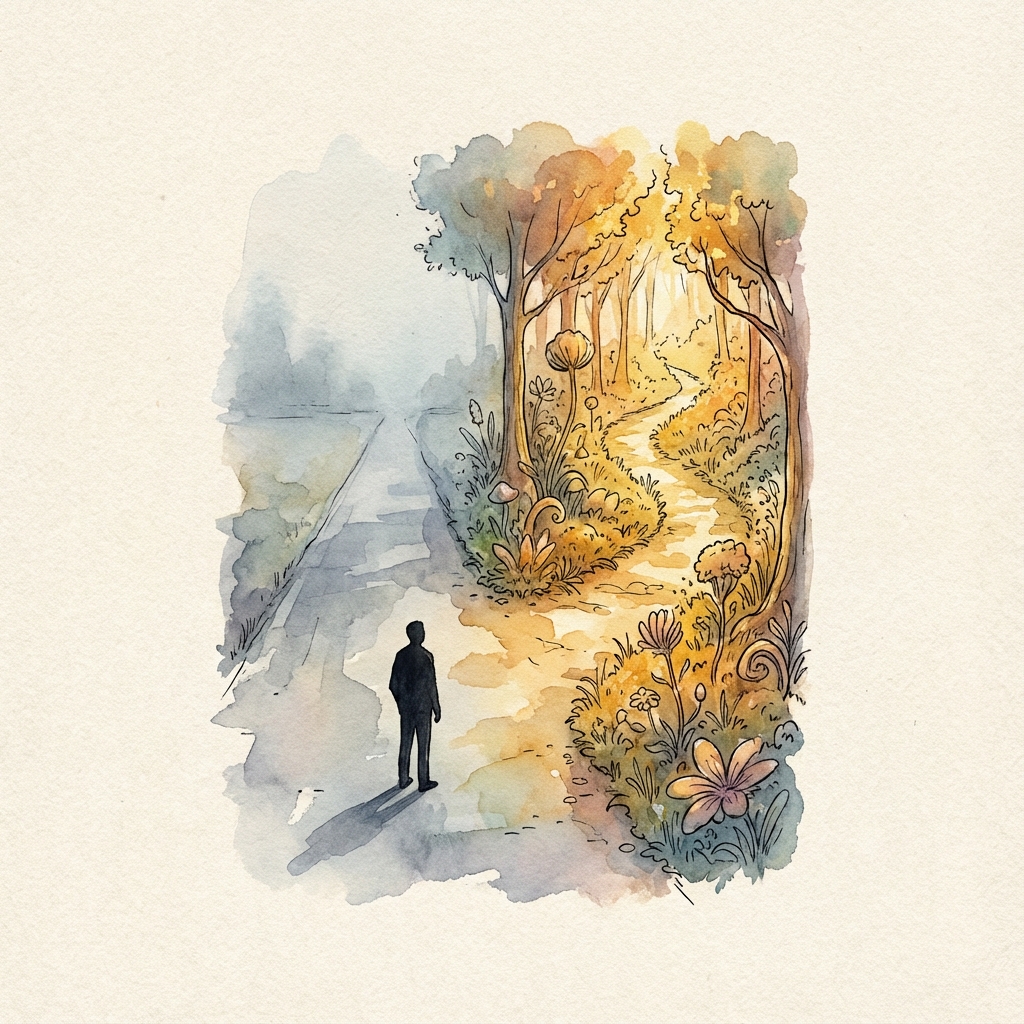
There is this amazing parsha in the Torah where God commands Abraham, “לך לך.” In Hebrew, “לך” means “go,” and “לך” also means “to you” or “for you.” So it can mean either “go to yourself” or “go for yourself,” but really both are fitting. God asks Abraham to leave his country, his home, and set out on a journey away from everything familiar, toward a land unknown to him. And God says:
“I will make you a great nation, I will bless you, and make your name great, and you shall be a blessing.”
While I didn’t grow up knowing much about the deeper meanings behind Judaism, the more I’ve learned as I’ve gotten older, the more I’ve come to see how beautiful it really is—because Judaism is a metaphor, a guide for our lives, and the very lessons I have come to learn through my own experiences.
There are endless ways to interpret this, but to me, לך לך means that it is our mission to go on a journey toward ourselves and for ourselves, no matter the level of fear or uncertainty. This path will always be the harder path.
In life, we choose to fit in because it feels safe. We choose not to voice our true thoughts when they go against the group because it feels safe. We choose what’s expected of us because it feels safe. We choose to stay comfortable because that’s what feels safe.
But I love this commandment from God because it emphasizes the true blessings that come when we choose the journey of non-safety—when we actually leave our comfy homes and go to ourselves and for ourselves.
I spent much of my life trying to fit in, trying to please others, suppressing my own beliefs and desires, staying comfortable. But every time I dared to push, dared to be disliked, dared to argue, to stand up for myself, to leave, to do the harder thing, blessings always followed.
I was born hyperactive, goofy, loud, stubborn, creative. I always felt like such a weirdo. I spent my life trying to fit into other people’s sweatpants—what was right for other people but not for me, what other people wanted me to be but what I wasn’t.
For a while, I was “stubborn.” I stood up for myself. I had strong emotions. I pushed back. And those things got punished. But it’s ironic, because I think the moment we should really start worrying is when people aren’t having emotions, when they stop standing up for themselves, when they stop pushing back for what they believe in. That’s where the real danger lies.
And yet, it’s praised. It’s praised to fit in, to not go against the grain, to follow what everyone believes.
I also really loved writing, poetry, art, and emotions—all the things I was taught were pretty much useless. So after a while, I gave up. I submitted. I stopped being unapologetically myself and started becoming someone I thought would somehow fit in better in this world. Someone who made less noise, got in trouble less, didn’t feel so much pain, got more praise and recognition.
I started taking ADHD medication so I could sit still, focus, be “better” at traditional school. I stopped being playful and goofy. I started running a lot, getting skinny. I developed an eating disorder. I majored in accounting and finance. I gave up on the things I was passionate about—writing, social work, people, laughter, creativity, art.
It wasn’t so clear-cut; the real me was still under there. But she got buried alive. I became so used to contorting myself to fit other people’s sweatpants that I could no longer even feel that I wasn’t wearing my own.
This metaphor comes to my mind like:
Friend: “How are the sweatpants?”
Me: “They’re great!”
(Also me in the mirror, looking like the letter X.)
My friend—same size as me—tries on the same pair.
Me: “So…?”
Friend: “Is this what it feels like to be cut in half?”
Basically, even though the sweatpants are so tight I can’t breathe, I’m so used to the sweatpants that don’t even go over my legs that a tight waist ain’t nothing for me.
I became used to that feeling—the feeling of not even realizing you aren’t living your own life until your body starts screaming for help. And over time, I snapped.
I hit rock bottom. I’d been having panic attacks for years. I was in an abusive relationship. I lost a lot of my friendships. I moved back home. I was depressed and hypomanic.
And I felt like I had lost everything.
But really, it was the biggest blessing of my life. Because I learned a lesson I’ll never forget:
“It’s only after we’ve lost everything that we’re free to do anything.”
The thing that makes us cling to what’s holding us back is the fear of losing what we have. But I had already lost everything.
And the truth is, what we think we’re “holding onto” is often an illusion. Sometimes, it’s the very thing that’s not good for us—the thing keeping us small, safe, and stuck—and holding us back from who we’re meant to become.
I hit a point where it was hard to see how I was going to continue living. Every day felt like holding on for dear life. I remember thinking, “The thing about life is that you have to live it every. single. day.” My body was having severe physical reactions. I felt unstable. I didn’t understand how I was going to live life every single day.
But because of that, I was given the most precious gift. I found the things that made life worth living again.
I came back to myself. I started doing the things I actually cared about. I brought back that goofy, free-spirited, sensitive girl. I started writing again, having emotions again. Only letting people into my life that actually treated me well and appreciated me. I decided to become a therapist—to do things that had meaning for me. I felt like I had nothing to lose anymore, and that gave me everything.
From then on, I started to finally live as myself again. I started to build a life that was actually mine. I went to myself and for myself.
I stopped caring so much about what other people thought, because I realized—how else am I supposed to live? Life is so fragile and precious. If you don’t live it doing the things that are meaningful to you, what’s the point?
So I quit my job in accounting. I stopped taking my ADHD medicine. I spent months getting back in touch with myself—the authentic self that got lost somewhere along the way. I started writing again, creating art again, making poems. I started crying again, actually having strong emotions again that had been buried for so long. I decided to go back to school to become a therapist. I decided to apply to a masa program and go to Israel.
But these things are never linear. It was a real process of unlearning, and I still am. At first, even after applying to Israel, I was too scared and decided instead to go to school in Chicago at Northwestern for counseling.
But it still didn’t feel right. I still felt a part of me wasn’t living for Dani. I was gravitating more toward Judaism at the time, and I found a good community of people in Chicago, but something still wasn’t right.
Something in me kept pulling me back toward Israel. When I came here as a teenager, I loved it so much. Every time I left the U.S. and came to Israel, this crazy thing happened—I felt like myself again.
There’s something special about the people and culture here. They don’t have this “sit down, shut up, and fit in” mentality. People say what they want. They live more authentically. Kids are freer to be who they are. They develop autonomy and confidence that’s so beautiful. Something in my gut told me I needed to go. That I needed to challenge myself, to grow, to learn, to struggle, to be on my own, to not know the language or anyone, to figure it out myself. I couldn’t explain it, but I knew it with my whole being.
I was scared to tell my parents that after all this—after quitting my job and moving to Chicago—that it still wasn’t what I wanted. I was still holding on to parts of me that were scared: scared of what my parents would think, scared of how I’d actually do something like this, scared that it wasn’t possible.
I finally admitted that I didn’t want to stay in Chicago and continue school, that I wanted to go on a Masa program and try living in Israel, but still go to school for therapy afterwards. My therapist told me about an amazing program in Israel where I could get a Master’s in Social Work both in the U.S. and Israel while living in Israel.
As I was sorting out all the details, something really horrible happened: October 7, 2023.
It happened about two weeks after I started feeling this insanely strong pull to come to Israel. And afterward, I felt an even stronger pull.
I finished my semester in Chicago while living alone. I felt disconnected from everything. It felt like no one knew what was happening in Israel—what Jews were experiencing. There were huge protests every day in Chicago. I felt scared and alone. I just knew with my whole being that I wasn’t where I was supposed to be.
What’s crazy is that before deciding to go to Northwestern, I had actually found all my old college essays—and in most of them, I was applying to study social work. I’d had a gut feeling all along that social work was my path, that it was my true passion. In high school, that was the kind of work that lit me up. But I hadn’t stood up for what I knew in my heart. I didn’t even know what I wanted anymore. And when you have that feeling—“I don’t know what I want”—it’s often because you’ve learned not to listen to yourself, so you forget how (hence the sweatpants metaphor).
Anyway, I just had this feeling I’d go to school for social work.
Fast-forward: I did everything in my power to still come to Israel, even after the war started. I quit school in Chicago, broke my lease, packed my apartment by myself, moved back home, applied to both a Masa program and the master’s program in Israel.
I was really scared to come. I’d recently had a hypomanic episode, struggled with depression, stopped taking ADHD medication and after a lot of push back, started taking Lamictal (a mood stabilizer) because I was terrified of ever feeling that unstable again. And now I was deciding to go to a country at war, across the world from home, with no friends or family there, not knowing a single soul. But somehow, I just knew I had to.
Leading up to it, I had so many doubts. Should I do this? Should I really do this? Is this stupid? But my parents just knew I needed it. No parent wants their child to move across the world to a country in the middle of war, and yet they were so supportive. When I told my mom I didn’t know if I could do it, she reminded me why I needed to—how much I wanted it, how much she knew it was exactly what I needed.
So I left. On my own. Really fucking scared.
And something crazy happened when I came here—when I started being myself, pursuing the life that was meant for me, meeting an amazing supportive partner who saw all of me and loved me for it. For the first time, I felt whole and integrated.
It didn’t matter that I was away from home, or that I was in a war zone. I stopped needing any medicine. I became whole and stable and happy, not in the sense that I’m just happy and great all the time, but in a sense that I feel alive. I feel my emotions. I want to live. I’m excited for my future, and I feel so whole. I still cry a lot. I still feel sad and overwhelmed a lot. But I couldn’t be more grateful because I actually am living life. I’m more than okay, I’m the best I’ve ever been, because I learned how to live for myself.
I left my home. I left the safety of what I had known. I left the version of myself built in survival. I took a chance. I walked into the unknown. I went on a journey by myself that I felt deeply called to. It’s scary. It’s still scary. I still struggle every day, and it’s been almost two years. But I went to myself and for myself, and in it came the biggest blessings of all.
Continue Reading
Be Your Own Creature
The mess is where our hidden gems live
The Roots and the Tree Inside Me (and You)
Blending a Jewish idea (Adam I/II) with my own "parts". The roots that know and the tree that shows and what it means to live an integrated, purposeful life.
The Walking Juxtaposition
Deep dive into the fragmented parts of self - Dennis, Dolly, Double D, and their protective counterparts