The Roots and the Tree Inside Me (and You)
Blending a Jewish idea (Adam I/II) with my own "parts". The roots that know and the tree that shows and what it means to live an integrated, purposeful life.
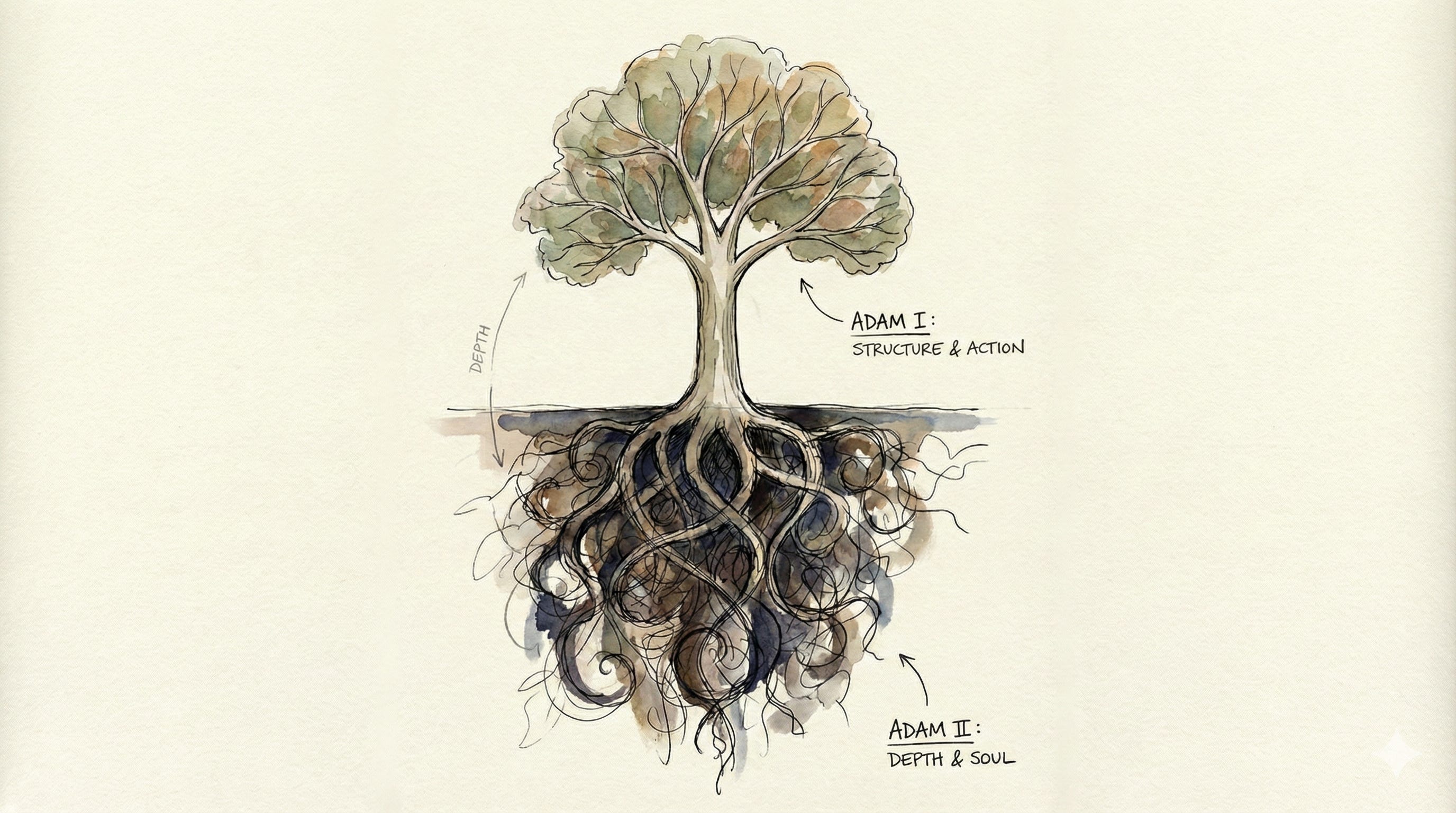
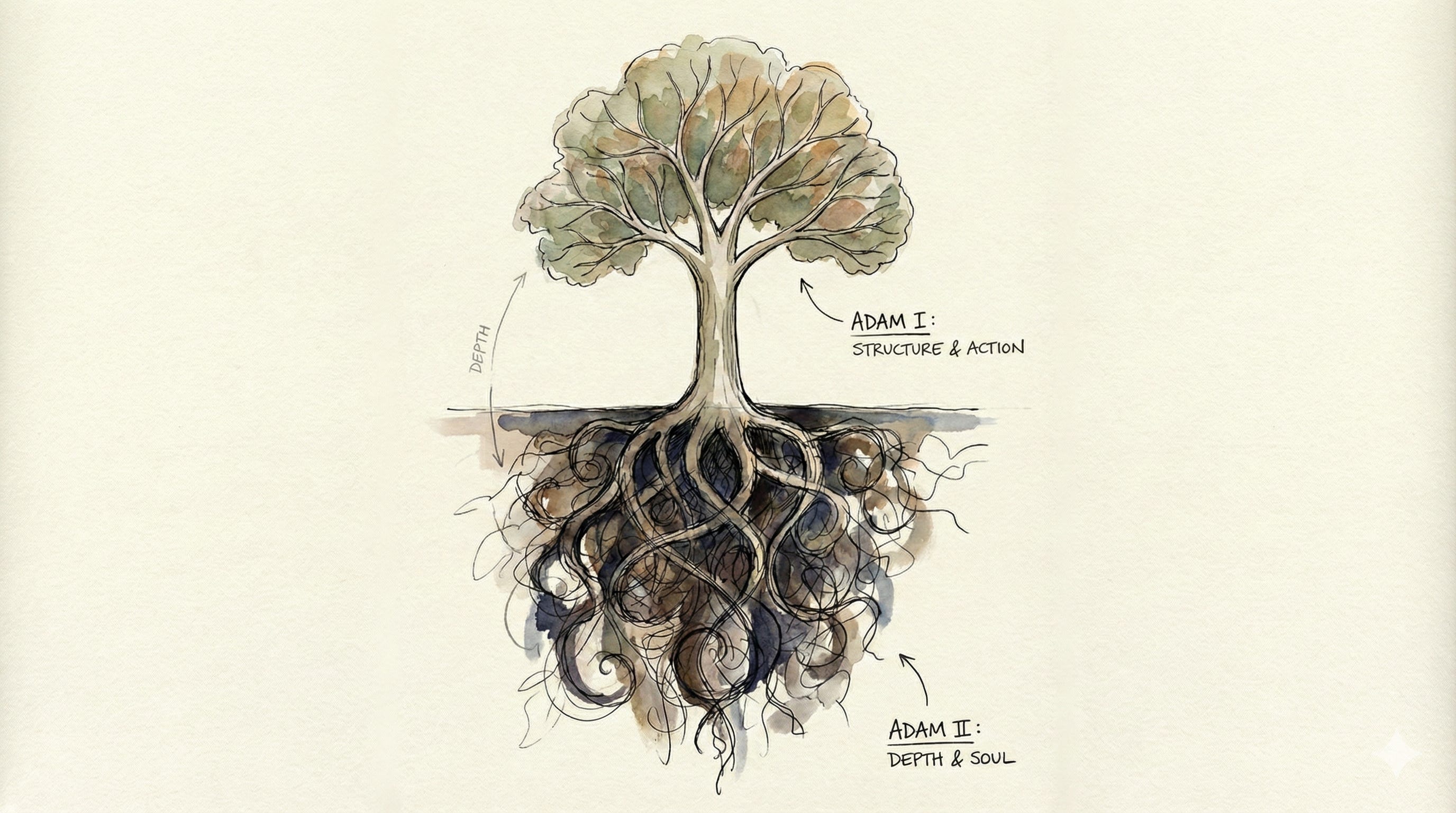
Adam I, Adam II
If you’ve read my other essays, you already know about the two “opposing” sides of me I’m always talking about. But the whole reason I share them is because I don’t actually think they’re unique to me at all—I think most of us have our own version of this split. Today I want to zoom out from the therapy/IFS lens and look at them through a more spiritual, Jewish framework, and explore how they show up not only in my story, but in all of ours.
After years of grappling with this “split identity”—this constant push and pull between DAN and DIDI—I was sitting in my Philosophical Foundations class when everything I’d been wrestling with in my own life suddenly had names.
By that point in the program, I’d already suffered through a lot of other classes that made my skin crawl: diagnosing people, labeling them, memorizing symptoms and medications, learning to speak a language that, to me, doesn’t actually get at the root of the problem. We were taught how to fit people into boxes so insurance would pay, how to turn human beings into codes so the system could “function.”
In one of those clinical classes (a different course, not the philosophy one), my teacher actually said the quiet part out loud after some of my peers started to question what we were being taught.
She started talking about how the mental health industry is basically built on corruption. How insurance agencies make you diagnose people in order to get paid. How everything is run by corporate interests. And instead of getting outraged or asking how we change it, she shrugged and told us:
“Well, if you don’t do it, your clients will just go to someone else who will, and you won’t make any money.”
I felt my whole body go hot. Angry, repulsed, disgusted. It took every ounce of my being not to slam my laptop shut and just leave the Zoom.
I remember sitting there thinking:
This is the very system that hurt me. The system that is still hurting other people. I can literally see the damage it does with my own eyes.
It’s the whole reason I went into this field. It’s the whole reason I write and speak. And here I am, sitting in class, being trained by people who are fully participating in the exact system they’re admitting is broken. Am I really just learning how to become part of it?
For a bit, I honestly wanted to quit school and somehow try to figure out how to become a therapist without it. I couldn’t imagine being another therapist who quietly feeds people into a machine that often disconnects them further from themselves. I didn’t want to be associated with therapists who are damaging people, who are literally part of the exact problem they claim to fix. I felt like I was watching the world try to heal trauma with the very tools that caused it.
I was sick to my stomach. But it also reminded me why I started at all.
I realized I had a choice:
I could give in, become another cog in this system, and deaden myself to my own discomfort. (There was no way in hell I was doing that—I’d rather do literally anything else.)
I could walk away in disgust and let my anger push me out of the field altogether, avoid it and hope that distance would somehow protect me from the pain and frustration.
Or I could gather myself, keep my head up, and do what I know best: try to change things. Write. Speak out. Talk about my knowledge, insights, and experiences. Help people in the ways I believe. Inform people, no matter how hard and painful it is.
So this essay is another attempt at doing just that.
And then, the very next day, back in my Philosophical Foundations class, something landed that really clicked for me.
We started reading Solovetchik’s essay The Lonely Man of Faith. Everything I’d been feeling in my own body—the split and oscillation between two sides—had language and a framework. For the first time in my whole program, I felt like someone was actually speaking my language, and that someone was Soloveitchik.
That class gave me the missing puzzle pieces for what I’d already discovered in my own life. It confirmed what my body had been screaming for years: we have overcomplicated being human. We’ve drifted so far from what actually keeps us healthy. We need to turn back to the deeper wisdom we were built from—philosophy, spirituality, Torah—because the blueprint for human beings is not the DSM.
And Soloveitchik so beautifully explains the grappling between two ancient archetypes: Adam I and Adam II within every human being.
Adam I, Adam II… and DIDI and DAN
He writes about two “Adams”—two dimensions that exist in every person, rooted in the biblical creation story.
Adam I is what he calls the “majestic man.” He’s created in the image of God and tasked with mastering and shaping the external world. He’s pragmatic, achievement-oriented, focused on utility and control. He asks how questions: How do we build? How do we succeed? How do we solve this problem? He uses science, logic, innovation. His relationships are functional—built for productivity and collaboration rather than emotional depth. Adam I wants to leave a mark on the world.
Adam II is the “covenantal man.” He’s formed from dust—symbolizing humility—and created in solitude. He’s introspective, spiritual, oriented toward meaning and vulnerability and deep connection. He asks why questions: Why are we here? Why do we suffer? Who am I? He seeks connection with God, with others, with himself. His yearning comes not from dominance but from surrender. Adam II wants to find his place in something larger.
When I heard this, I couldn’t not think of my own inner world.
When I first started understanding this split, this is how I saw DIDI: the part of me who runs on ego, fear, proving, performance. The one who chases approval, stays in control, does whatever it takes to look put-together. The straight-A student, the disciplined athlete, the “good girl.” On paper, a success story. Inside, hollow.
For years I blamed her for my emptiness. I saw her as fake—”not the real me.” Every time I caught myself chasing validation or performing, I’d think, ugh, that’s DIDI again , and feel ashamed.
DAN was the opposite. The creature. The kid who doodled poems in the margins instead of doing the worksheet. The one who cries at everything, who would rather talk about the meaning of existence than actually build something in it. She felt like my real self—curiosity, intuition, spirituality, depth.
DIDI looked a lot like Adam I. DAN looked a lot like Adam II.
For a long time I thought the solution was to kill off DIDI and only be DAN because I was so scarred from living so much out of my Adam I traits.
But, Adam I is not inherently bad. DIDI is not inherently bad.
Adam I, when he’s in relationship with Adam II, serves an incredible purpose. He’s the one who actually builds the life the soul is asking for. He takes vision and makes it real. He translates “why” into “how.”
The problem was never that I had an Adam I. The problem was that my Adam I had been cut off from my Adam II.
A World That Rewards One Adam and Starves the Other
Most of us learn to disconnect from our Adam II pretty early.
We grow up in families, schools, and cultures that reward performance, certainty, productivity, and control. We’re praised when we sit still, get good grades, follow the rules, make ourselves easy to manage.
As a kid I was creative, emotional, stubbornly curious. I cared deeply about things that felt meaningful to me and could not make myself care about things that didn’t. I struggled to sit still in class. I struggled to fit into systems. Eventually I started taking ADHD medication that made it easier to focus, easier to do what was expected.
My Adam I thrived on that. Structure, focus, achievement—I finally started getting the praise and approval I had been starving for.
But it came at a cost.
The medication didn’t just quiet my distractibility; it quieted parts of my soul. The messy, spontaneous, creative, intuitive sides of me got pushed down so the functional parts could take the wheel. I was “succeeding,” but not necessarily at the things I truly cared about. I was living a version of myself that looked great on paper and hollow on the inside.
I see this everywhere now, especially in the U.S. We treat people’s pain with things that make them more functional but not necessarily more whole. We push medication to make people more productive, more numb, more able to tolerate a life that might actually be wrong for them.
It’s like we collectively decided that Adam II is bad for the economy.
Emotions, existential questions, spirituality, moral discomfort, curiosity—these are treated as symptoms to be managed, not signals to be honored. We suppress the very part of us that asks “Why?” so that our Adam I can keep grinding, building, chasing, performing.
And then we’re shocked about living in an era with so much depression, anxiety and disconnect.
Viktor Frankl, the psychiatrist who survived Auschwitz, wrote about this decades ago. He called it the “existential vacuum”—the emptiness that comes when people have their physical needs met but lack meaning. It leads to apathy, boredom, addiction, depression. We have more prosperity and technology than ever before in human history. And we are lonelier, more anxious, more disconnected than ever.
I really believe a huge piece of our mental health crisis comes from this: a society that has overdeveloped Adam I and starved Adam II. We are training people to be incredibly good at doing, and increasingly lost at being.
When Adam I Runs Without Adam II… and When Adam II Has No Adam I
Soloveitchik says the real challenge of life is not choosing one Adam over the other, but holding both. Maturity is the integration of action and contemplation, building and becoming.
My life has shown me what happens when that balance collapses in both directions.
For years I lived almost entirely as DIDI—a hyper-Adam I. I chased achievement, relationships, external validation. I performed whatever version of myself I thought would be accepted and loved. I got into situations where I was mistreated and stayed, because my Adam I side was desperate to prove I was worthy, to make it work, to not fail.
On the outside I looked strong and driven. On the inside I was depressed, fragmented, and spiritually starving.
Then, after everything crumbled, I swung the other way like a pendulum.
I wanted to be only DAN. I felt ashamed of everything that smelled like Adam I: wanting to be successful, wanting approval, even wanting money. I became obsessed with meaning, writing, healing, therapy, spirituality. I wanted to sit with my journal, my mushrooms, my feelings. I wanted to dig and dig and dig inside myself.
And that brought its own kind of suffering.
When I live only as Adam II, I end up in this place of loneliness and spiritual constipation. My head and heart get full of ideas, insights, and truths about the world, but I feel incredibly alone with it and nowhere to actually put them.
I have visions and can’t build them. I know I’m here for something and can’t deliver it.
It feels horrible—not empty in a numb way, but the opposite: so full of emotion and awareness that I get stuck and can’t move at all. Lonely, resentful, overwhelmed. I walk around seeing how disconnected everyone is from themselves and feeling like I’m screaming into a void.
That’s when I realized: Adam II without Adam I is just as painful as Adam I without Adam II.
When Adam I runs with no connection to Adam II, you can build an impressive life that has nothing to do with your soul. You end up successful and shattered, productive and empty, medicated enough to keep going but not awake enough to ask if this is the life you actually want.
When Adam II runs without Adam I, you can have all the awareness in the world and still feel like you’re failing your purpose. You can know exactly what you’re here to do and have no scaffolding, no structure, no plan, no discipline to actually do it.
Both sides suffer when they’re alone.
Letting Adam I Serve Adam II
I’m still not “balanced.” I don’t think balance is a place you arrive at once and for all. I think it’s a lifelong tension.
But I do know this now:
Adam II needs to guide. Adam I needs to serve.
Our Adam II—our soul, curiosity, conscience, intuition, spirituality—is where our real purpose and values live. That’s the part that has to answer the questions first: Who am I? What matters to me? What am I here to serve?
Once that is at least partially in view, Adam I gets to do what he’s actually good at: build it.
When Adam I is connected to Adam II, he’s not diminished—he’s actually more functional. More motivated. More energetic. Because he’s not running on fumes anymore, forcing himself forward through sheer discipline. He’s plugged into something real. Our emotions, our energy, our sense of purpose—they’re all connected. When Adam II is alive and guiding, Adam I doesn’t have to be dragged into action. He wants to move. The motivation isn’t manufactured—it’s natural. This is the difference between forcing function and true function.
Now Adam I can make the schedule. Structure the book. Create the website. Go to school. Train the body. Show up to clients.
Not to feed the ego, but to deliver what Adam II knows is true.
When Adam I is in right relationship with Adam II, he becomes a holy contractor for the soul. And when Adam II is honored and safe, he doesn’t have to hide; he can trust that what he knows will actually be lived.
I think this has to start early. As kids, we need spaces where our Adam II can actually breathe—where curiosity, emotion, sensitivity, intuition, spirituality are seen as essential, not as problems. Where we’re not forced to leave our souls at the door in order to “succeed.”
For those of us who didn’t get that, the work as adults is to nurture Adam II back to life and retrain Adam I. To stop treating doing and reflecting as enemies. To realize that if we are always doing, we can’t hear ourselves, and if we are always reflecting, we never build the life we actually want.
I don’t have a neat resolution. I still swing.
But I’m starting here:
Start with Adam II—with honesty, curiosity, mess, authenticity. Let that part name what I’m here for. Then bring in Adam I to build structures that actually serve that, not my fear.
We live as our unique emotional, intuitive selves, and we also learn how to deliver our unique gifts in the material world. That’s wholeness.
Not just functioning. Not just feeling. A life where both Adams in us all are finally working on the same team.
Adam II is the roots, Adam I is the tree —without one we can’t grow, without the other we can’t be seen.
Continue Reading
Be Your Own Creature
The mess is where our hidden gems live
לך לך (Lech Lecha) — Go To Yourself
The journey of leaving comfort and familiarity, moving to Israel, and following one's calling despite fear
The Walking Juxtaposition
Deep dive into the fragmented parts of self - Dennis, Dolly, Double D, and their protective counterparts